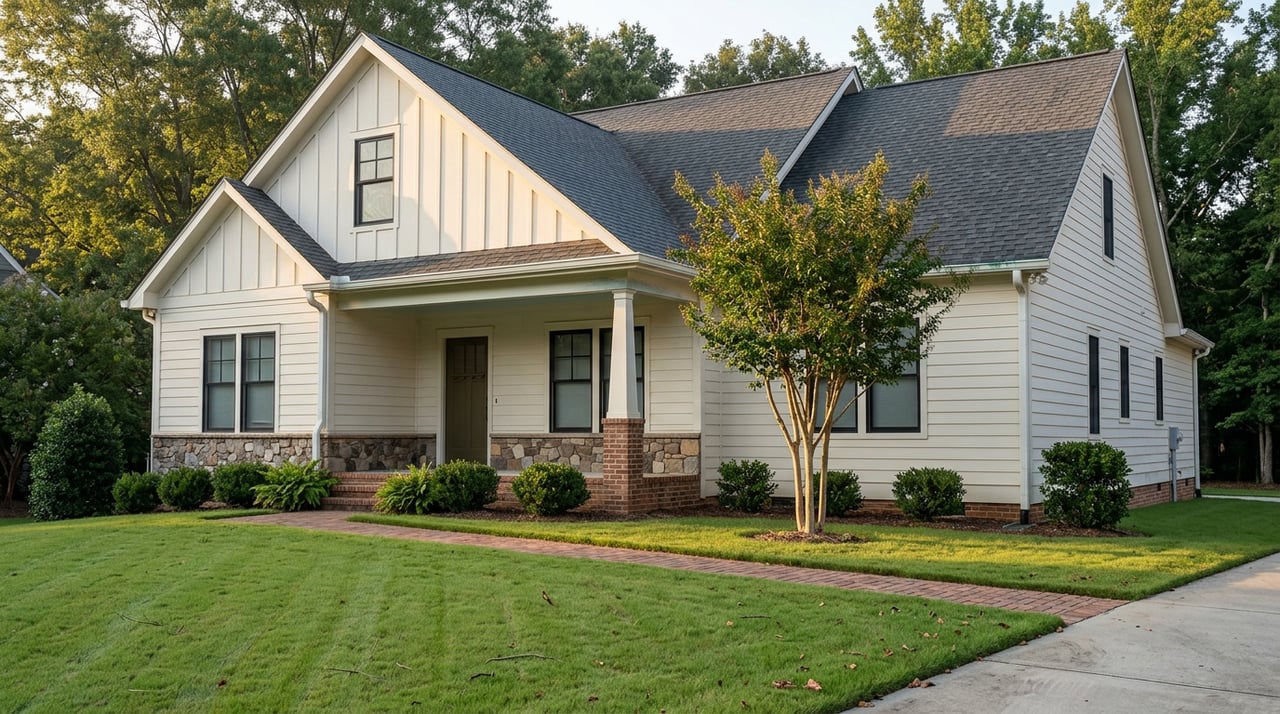
Drive Old US Highway 1 west of Apex and you will pass 190 acres of quiet farmland near Shearon Harris Road, not far from Duke Energy's nuclear plant and the Western Wake Regional Water Reclamation Facility. Nothing about the land looks different today than it did two years ago. No listing agent flags it. No portal search filters for it. But that parcel sat at the center of the biggest local land use fight the Triangle has seen this year, and the outcome of that fight still shapes what buying near New Hill actually means right now.
If you have been comparing New Hill to Apex or Cary using nothing but median price and days on market, you have the numbers. You are missing the mechanism. Here is what the price alone will not tell you.
New Hill Isn't Actually a Town
This is the part most out-of-area buyers never learn until they are already under contract. New Hill has no mayor, no town council, no zoning board of its own. It is unincorporated Wake County land, which means decisions about how a given parcel there can be used get made by whichever neighboring municipality eventually annexes it, most often Apex, sometimes Cary.
That single fact explains why a 190-acre farm property in New Hill, zoned residential and sitting in unincorporated Wake County, ended up in front of the Apex Town Council rather than any body based in New Hill itself. The developer needed Apex to annex the land and rezone it before it could build anything at that scale. Apex said no, but Apex is also the entity that will say yes or no to the next proposal, and the next one, on land it has not annexed yet.
For a buyer, this means the town whose planning department you should be calling is not always obvious from the address on the listing.
What Almost Got Built Off Old US-1
The project was called the New Hill Digital Campus, proposed by Natelli Investments, later doing business as Natelli Holdings. The plan called for four data center buildings, each roughly 200,000 square feet and 70 feet tall, built for somewhere between 250 and 300 megawatts of computing capacity depending on the report, to support cloud and AI operations. At peak summer demand, the facility was projected to draw as much as one million gallons of water a day for cooling, pulled from the Western Wake Regional Water Reclamation Facility next door.
Residents organized fast. The Protect Wake County Coalition formed to fight the project, and an online petition against it eventually drew more than 5,000 signatures. U.S. Rep. Valerie Foushee publicly opposed the proposal in late February 2026. Concerns centered on noise from roughly 80 backup generators, water draw during drought, and strain on a stretch of Wake County that was never planned around industrial-scale infrastructure.
On March 5, 2026, Natelli withdrew its annexation and rezoning applications. The Protect Wake County Coalition called the withdrawal a chance for Apex to slow down, put the right ordinances in place, and protect the community before any future proposal moves forward, adding that the conversation was not over.
A Pause, Not a Verdict
Here is where most coverage of this story stopped, and where a buyer's due diligence should actually start.
Within days of the withdrawal, the Apex Town Council voted unanimously to have staff draft a moratorium. Mayor Pro Tem Terry Mahaffey introduced the motion, telling the council the town needed the time and space to develop real rules. On April 14, 2026, the council formally adopted a 12-month ban on data centers, data processing facilities, and cryptocurrency mining operations, effective April 28, 2026 through April 27, 2027. Mayor Jacques Gilbert told local reporters he does not see a path forward for data centers in Apex. Council Member Shane Reese said the town intended to protect its air, water, power, and residents while it built out real rules.
That moratorium is not a permanent ban. It is a 12-month clock, and it has a specific carve-out: small-scale data processing tied to a hospital, financial institution, office, or school still qualifies as an accessory use and is not restricted. The moratorium targets large, standalone campuses like the one Natelli proposed, not every server room in Wake County.
Natelli has said on the record that it may bring the project back if Apex's zoning ordinance changes to explicitly allow data centers once the moratorium lifts. The land itself is still designated for future industrial employment on Apex's long-range land use map, even though its current zoning is residential. That gap between what the town's future plan says and what the parcel is zoned for today is exactly the kind of detail that never shows up in an MLS listing.
What Your Money Actually Buys, Compared
New Hill has been commanding a real premium over its neighbor. As of August 2026, New Hill homes listed for a median of $740,000, compared to $623,000 in Apex over the same month, roughly 19 percent higher. Price per square foot ran about $250 in New Hill versus $240 in Apex, and New Hill homes spent a median of 61 days on market compared to 70 in Apex.
None of that spread tells you anything about the zoning question sitting a few miles down Old US-1. A home in an established New Hill subdivision, fully built and occupied, carries none of this risk today. Raw land or new construction sites closer to the Old US-1 and Shearon Harris Road corridor carry a different profile, one tied to a moratorium that expires in eight months and a developer that has already said it plans to watch what happens next.
What This Means If You're Comparing New Hill to Apex or Cary
The premium you pay in New Hill buys you proximity to a growth corridor that is still being negotiated in real time. That is not automatically a downside. Growth corridors are often where long-term value gets built. But it changes the questions worth asking before you write an offer on anything near that stretch of road.
Before buying land or new construction near Old US-1, Shearon Harris Road, or Friendship Road, ask your agent to pull the current zoning on the specific parcel, not just the subdivision's marketing name. Ask whether the parcel appears on Apex's long-range land use map as designated for anything other than residential use. Ask whether the seller or builder knows if the site was ever part of an annexation petition. And keep April 27, 2027 on your calendar, because that is when Apex's moratorium expires and the town's Environmental Affairs Board is expected to have drafted the permanent rules that will decide what comes next.
None of this means avoid New Hill. It means buy with the full picture, not just the price chart.
A Few Questions Worth Asking
Is the data center project completely dead? No. Natelli withdrew its applications in March 2026, but the company has stated it may revisit the project once Apex's moratorium ends and if the town's zoning ordinance changes to allow data centers as an approved use.
Does this affect homes that are already built and occupied nearby? Not directly. The moratorium and the underlying land use questions apply to new development proposals, not to existing homes. The relevance is for land purchases, new construction, and long-term resale planning in the affected corridor.
How do I check the zoning on a specific parcel in New Hill? Because New Hill is unincorporated, zoning questions route through whichever town has annexed or has jurisdiction over that parcel, most commonly Apex. Ask your agent to confirm current zoning and check the parcel against Apex's long-range land use designation before you make an offer.
When does the moratorium end? April 27, 2027. After that date, Apex's town council could adopt new data center rules, extend the pause, or let the moratorium expire without new regulation. Any of those outcomes changes the calculus for land near the original proposed site.
If you are weighing New Hill against Apex, Cary, or another Triangle suburb and want someone who tracks these local land use shifts as closely as the price data, that is exactly the kind of groundwork DiProfio Homes does before a client ever writes an offer. Reach out and we will walk through what a specific parcel's zoning history actually means for your search.
